7 Best DORA Metrics Tools in 2026 (Honest Comparison)
Not all DORA metrics tools are equal. We compared LinearB, Swarmia, Gitrecap, Jellyfish, and more so you can pick the right tool for your team size and budget.
What to Look for in a DORA Metrics Tool
Not all DORA metrics tools are created equal. The core challenge is that accurate DORA measurement requires reliable data — and the quality of that data depends heavily on how well the tool integrates with your actual software delivery workflow.
When evaluating DORA metrics tools, consider the following dimensions:
- Data sources: Does the tool connect natively to GitHub, GitLab, or Bitbucket? Does it integrate with your CI/CD platform (GitHub Actions, CircleCI, Jenkins)? Incomplete data sources produce misleading metrics.
- Accuracy of metric calculation: Does the tool correctly identify deployments vs. merges? Does it handle monorepos, multiple services, and non-standard branching strategies? Deployment frequency is easy to calculate incorrectly.
- Ease of setup: How long does it take to go from sign-up to seeing real metrics? Tools that require extensive configuration or custom tagging create adoption friction.
- DORA tier benchmarking: Does the tool classify your performance against the official DORA tiers? Seeing raw numbers without context is less actionable than knowing whether you are Elite, High, Medium, or Low.
- Pricing: DORA metrics tools range from free (Apache DevLake) to tens of thousands of dollars per year (Jellyfish, Faros). The right pricing tier depends on your team size and how much you value additional features beyond raw metrics.
- Additional engineering metrics: Many teams want DORA metrics alongside cycle time, PR analytics, and team workload data. Tools that combine these reduce the number of dashboards engineers need to check.
The Best DORA Metrics Tools Compared
The following reviews cover the leading DORA metrics tools available in 2026, based on their feature sets, integration depth, pricing, and ideal team profile.
1. Gitrecap — Best for GitHub-First Teams
Gitrecap is purpose-built for teams that use GitHub as their primary development platform. It calculates all four DORA metrics directly from GitHub data — pull request history, merge events, release tags, and CI/CD workflow runs — with no additional instrumentation required.
Beyond DORA metrics, Gitrecap includes PR cycle time tracking, code review analytics, team contribution summaries, and automated Slack and email reports. This makes it a comprehensive engineering analytics tool rather than a narrow DORA-only solution.
- Who it is for: Engineering teams of 5 to 200 developers using GitHub, who want DORA metrics alongside PR cycle time and team reporting without enterprise pricing
- Standout features: Automatic DORA tier classification, cycle time breakdown by phase, weekly automated reports to Slack or email, multi-repo support
- Pricing: Affordable monthly pricing per active contributor; free trial available
- Setup time: Under 5 minutes to connect GitHub and see initial metrics
See the full Gitrecap DORA metrics feature overview for a detailed breakdown of how each metric is calculated.
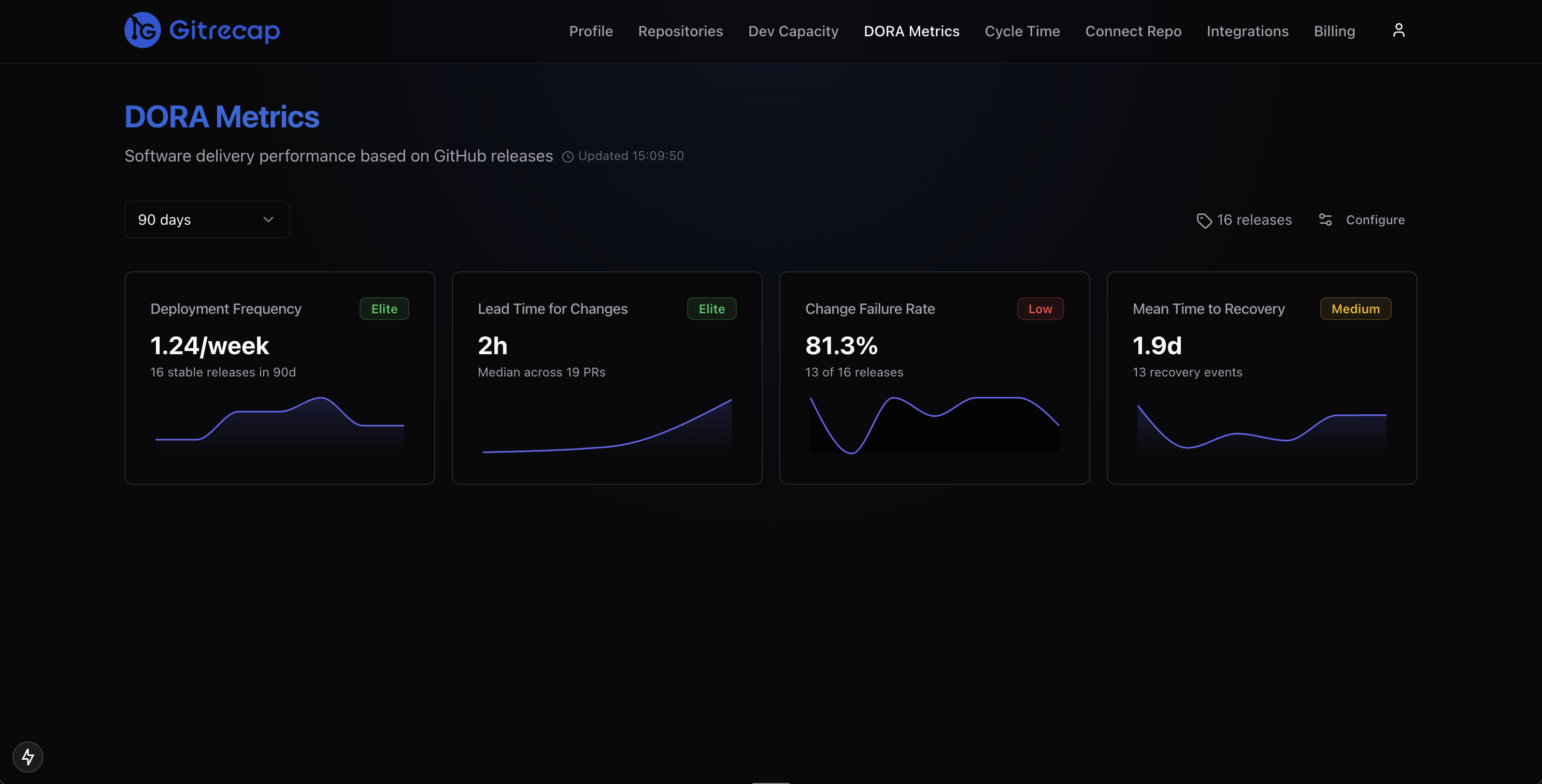
Gitrecap displays your current DORA tier alongside trending data so you can track improvement over time.
2. LinearB — Best for Workflow Automation
LinearB is a comprehensive engineering management platform that goes well beyond DORA metrics into active workflow automation. Its flagship product, gitStream, allows teams to define automated rules for PR routing, reviewer assignment, and merge conditions — turning metric insights into automated process improvements.
LinearB supports GitHub, GitLab, and Bitbucket, and integrates with Jira and Linear for issue tracking context alongside Git metrics. The DORA metrics dashboard is mature and includes benchmarking, trend analysis, and team comparison views.
- Who it is for: Engineering managers at mid-to-large organizations who want workflow automation alongside metrics, and have the budget for an enterprise platform
- Standout features: gitStream PR automation, engineering benchmarks, team health indicators, sprint metrics
- Pricing: Enterprise pricing; typically requires a sales conversation for larger deployments
- Setup time: Multiple days to configure fully; gitStream automation requires workflow definition
3. Swarmia — Best for Developer Experience
Swarmia combines DORA metrics with SPACE framework indicators, including developer satisfaction surveys and focus time tracking. This makes it the strongest choice for teams that want to understand not just what their delivery system produces but how developers experience their work.
Swarmia has a clean, well-designed interface and strong PR analytics alongside DORA metrics. It integrates with GitHub, GitLab, Jira, and Linear, and includes team health features like investment distribution tracking.
- Who it is for: Engineering leaders at companies of 30 to 300 developers who prioritize developer experience alongside delivery metrics
- Standout features: Developer satisfaction surveys, focus time tracking, SPACE metrics alongside DORA, clean benchmarking UI
- Pricing: Per-seat pricing in the mid-to-upper range; more expensive than Gitrecap, less than Jellyfish
- Setup time: 1 to 2 days including survey configuration
4. Jellyfish — Best for Executive Reporting
Jellyfish is positioned as an engineering management platform for large organizations that need to communicate engineering value to executive stakeholders. Its primary differentiator is engineering investment allocation — showing what percentage of engineering capacity goes to features, tech debt, bugs, and infrastructure.
DORA metrics are available in Jellyfish but are one component of a broader executive reporting suite. The platform integrates with GitHub, GitLab, Jira, and financial systems to create cross-functional views of engineering output and cost.
- Who it is for: VPs of Engineering and CTOs at companies of 100+ developers who need to report engineering ROI to boards and C-suite
- Standout features: Engineering investment allocation, C-suite dashboards, financial system integration, roadmap alignment views
- Pricing: Enterprise pricing; typically $100,000+ per year for larger deployments
- Setup time: Weeks; requires integration configuration and stakeholder alignment
5. Apache DevLake — Best Open Source Option
Apache DevLake is the leading open-source engineering analytics platform and the only option on this list that is completely free. It ingests data from GitHub, GitLab, Jira, Jenkins, and dozens of other tools into a unified data lake, then provides pre-built dashboards for DORA metrics and other engineering indicators.
DevLake is a strong choice for teams with infrastructure engineering capacity who want full control over their data and do not want to pay per-seat SaaS pricing. The trade-off is setup and maintenance overhead — DevLake requires Kubernetes or Docker deployment, database management, and ongoing maintenance.
- Who it is for: Engineering teams with DevOps/platform engineering capacity who want a free, self-hosted, highly customizable solution
- Standout features: Fully open source, self-hosted, 40+ data source plugins, extensible with custom metrics
- Pricing: Free (Apache License); infrastructure costs apply
- Setup time: Multiple days to deploy, configure, and connect data sources
6. Faros AI — Best for Multi-Source Integration
Faros AI is an enterprise engineering intelligence platform that distinguishes itself through breadth of integration. It connects to 50+ tools across the software delivery lifecycle — from GitHub and GitLab to PagerDuty, Datadog, Workday, and ServiceNow — to create a unified view of engineering operations.
DORA metrics in Faros AI can be calculated from a wider range of data sources than most tools, which is valuable for organizations with complex, multi-tool delivery chains. The platform also includes an AI layer for anomaly detection and root-cause suggestions.
- Who it is for: Enterprise engineering organizations with complex, multi-tool delivery chains and a need for unified operational visibility
- Standout features: 50+ integrations, AI-powered anomaly detection, custom metric definitions, data warehouse export
- Pricing: Enterprise pricing; requires custom quote
- Setup time: Weeks to months depending on integration scope
DORA Metrics Tools Comparison Table
| Tool | GitHub | GitLab | Pricing | DORA | Cycle Time | Setup |
|---|---|---|---|---|---|---|
| Gitrecap | Native | No | Affordable | Yes | Yes | 5 min |
| LinearB | Yes | Yes | Enterprise | Yes | Yes | Days |
| Swarmia | Yes | Yes | Mid-range | Yes | Yes | 1–2 days |
| Jellyfish | Yes | Yes | Enterprise+ | Yes | Partial | Weeks |
| Apache DevLake | Yes | Yes | Free | Yes | Yes | Days |
| Faros AI | Yes | Yes | Enterprise | Yes | Yes | Weeks+ |
How to Choose the Right DORA Metrics Tool
The right DORA metrics tool depends on your team size, budget, Git platform, and how much value you place on features beyond raw metric tracking. Use the following framework to narrow your options.
Small teams (fewer than 20 developers): Prioritize low cost, fast setup, and minimal maintenance. Gitrecap is the strongest choice if your team is GitHub-based — you can have metrics running in under 5 minutes with no infrastructure to manage. Apache DevLake is the right choice if your team has infrastructure engineering capacity and wants a free, self-hosted solution with GitLab support.
Mid-size teams (20 to 100 developers): You can afford to consider more feature-rich options. Gitrecap remains the best value if GitHub is your primary platform and you want DORA alongside cycle time and automated reporting. Swarmia is the right choice if developer experience metrics and surveys matter to your culture. LinearB makes sense if you want to invest in workflow automation through gitStream alongside metrics.
Enterprise teams (100+ developers): At this scale, the cost of the tooling itself matters less than the depth of integration and the quality of executive reporting. Jellyfish is the strongest choice for organizations that need to communicate engineering investment allocation to boards and C-suites. Faros AI is the right choice for organizations with complex multi-tool delivery chains that need unified visibility across 50+ systems. LinearB remains competitive if workflow automation is a priority.
Our recommendation: Most teams are best served by starting simple. Connect Gitrecap or DevLake, get baseline DORA metrics, and spend your energy on improving the metrics rather than configuring the tooling. You can always migrate to a more feature-rich platform once you have outgrown the basics. The most expensive tool in the world does not help if your team is not using the insights it surfaces.
For teams on GitHub that want the fastest path to actionable DORA metrics, DORA tier classification, and cycle time analytics in one place, start with Gitrecap's DORA metrics dashboard.
Ready to Automate GitHub Activity Tracking?
If you'd like to automate GitHub activity tracking, try Gitrecap — no sign-up required.
Related Articles
How to Track GitHub Activity Like Jira (Without the Complexity)
Tired of complex project management tools? Discover how to track GitHub activity with Jira-like visibility using simple, automated reporting tools.
5 Free Tools to Track GitHub Team Activity Automatically
Discover the top 5 free tools that automatically track GitHub team activity, helping you monitor productivity without manual work.